Office lighting is a very important aspect of the work environment, because the light we receive while working affects our sense of well-being. Therefore, it can negatively impact performance during the workday. This is why choosing the most suitable lighting for each workspace is essential. In this article, we discuss the regulations that exist on the subject, the types of lights that can be installed, and some useful tips related to the topic.
Office lighting: regulations, types, and some tips
5 min read
)
Office lighting is very important for the good performance of workers. Here we explain what types of lights exist and offer recommendations.
Office light level regulations
First, the CTE regulation states that buildings must be designed with the aim of making the most of natural light. This is something that benefits workspaces that have windows or large openings to the outside. In addition to allowing energy savings, it offers the best possible office lighting.
However, according to Spanish Royal Decree 486/1997, it must be complemented with artificial lighting when natural light alone does not guarantee adequate visibility conditions. In that case, we turn to the different types of lights that exist, taking into account the minimum required light level, depending on the visual demands of the space.
According to the UNE-12464 standard, the general amount of light an office must have is 500 lux with 0.6 uniformity. Although its different areas have different values calculated based on visual comfort, visual performance, and safety. These are the recommended levels established by the European standard for each area:
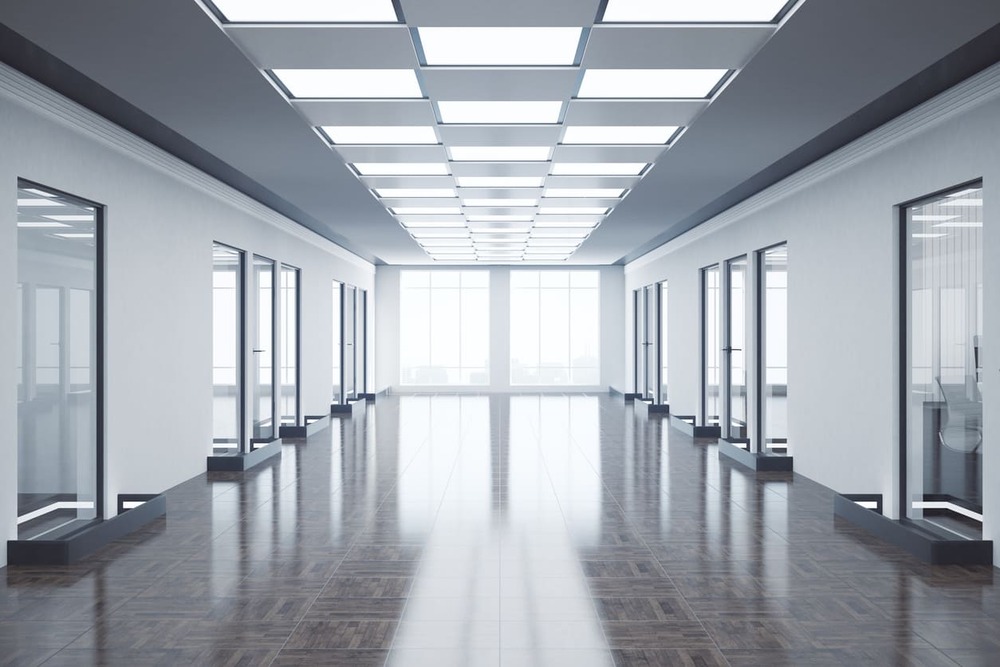
Circulation areas: between 150 and 500 lux.
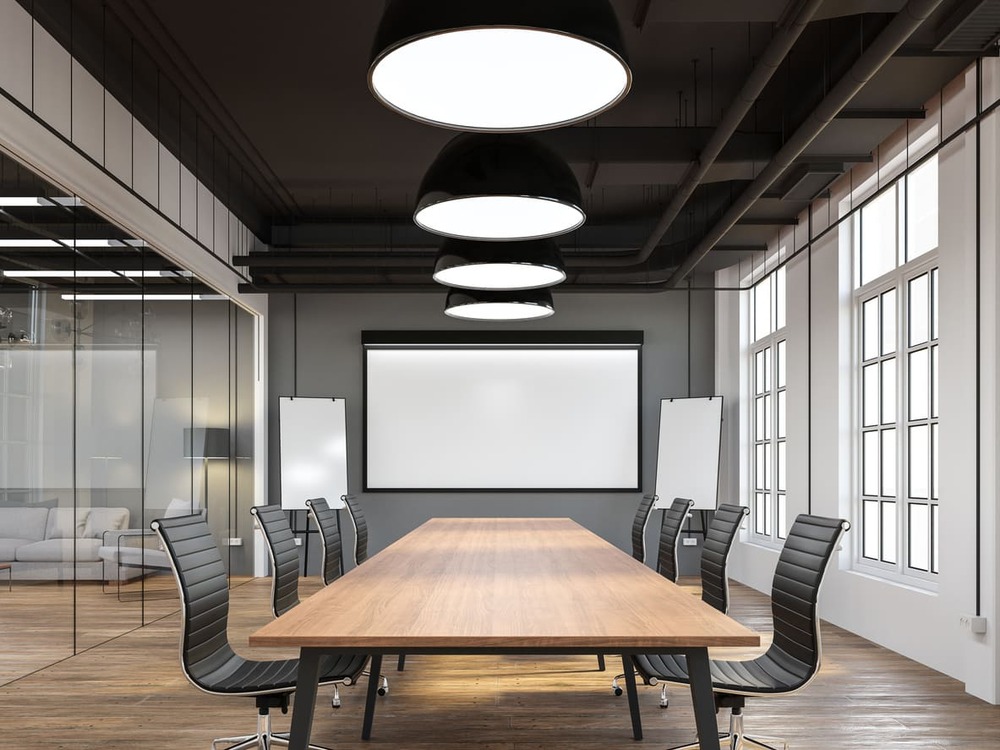
Meetingrooms: between 200 and 350 lux.
Administrative work desks: between 400 and 700 lux, increasing to between 600 and 1,500 for design or drawing tasks.
How should office lighting be?
All types of light characteristics must be considered: color, intensity, uniformity, dimming, tone, shadows, etc. It is also important to think about the combination of different types of lights, in order to provide the uniformity required for each workspace and its surrounding areas. Knowing all of this is essential to be able to choose office lighting, which can be:
Natural: natural light should take priority above everything else, both to save energy and to improve well-being and work performance. It is also necessary to have blinds or curtains, as they allow the regulation of incoming light to avoid glare or to perform certain tasks.
Biodynamic: a type of light that adapts its color temperature according to the time of day and circumstantial needs. In this way, it aligns better with workers’ biological rhythms and promotes their well-being. It provides good visibility for performing work tasks.
General: this is the lighting that provides direct and uniform illumination to a large part of a working area. Recessed ceiling lights are usually installed, such as Simon Hole, 800, 703, and 704, or modular luminaires. The Simon 860 linear lighting system or perimeter LED tubes can also be used.
Focal: this type of office lighting provides a localized and intense light in a very specific area. It is necessary when carrying out detailed work such as technical drawing, since otherwise we may experience visual fatigue and tiredness. For example, we highlight the Simon 740 projector collection or Point 56.
Automation of office lighting
In addition to choosing the right office lighting, we recommend having an automated system. It allows you to control and program the lights. These functions provide greater comfort in daily use, and they also help reduce energy consumption, which translates into greater economic savings.
Programming: thanks to automated systems, you can schedule the switching on and off of the lights at a specific time. In this way, they will never remain on throughout the night or the weekend, for example.
Dimming: being able to adjust the intensity of the light is ideal, especially in the meeting room, where you may need a dimmer light to give a slide presentation or view a projector.
Presence sensors: CLC (Constant Light Control) brightness sensors allow movement to be detected very precisely. When a person is in a passage area, they activate automatically, increasing safety and energy savings.
Scenes: configuring scenes is quite useful if you need a specific lighting setup. With a single click from your phone you can switch several lights on and off, or even control other devices such as blinds.
Remote control: smart lights can also be easily controlled from your mobile or tablet. Having them in office lighting provides greater comfort compared to traditional lighting.
How to light an office? Tips
Now you know which types of lights you should choose for your workspace, considering everything described above. Other useful tips on how to light an office are:
Install luminaires at the highest possible height.
Calculate the placement well and use diffusers so that they do not reflect on computer screens or other devices in the space.
Distribute light points with planning, ensuring there are no darker corners. Combine general office lighting with focal lighting.
Avoid excess, since it can be very uncomfortable for working. The light intensity should be between 500 and 750 lux.
Install white lights (between 3,000 and 4,000 kelvin).
In short, consider all of this to achieve excellent office lighting. We recommend taking a look at Simon’s product catalogue. You will find all kinds of lighting systems that combine connectivity, design, control, and well-being, with many different options equipped with the latest technology.