ITC BT-52 on “Special-purpose installations. Infrastructure for the charging of electric vehicles” was approved in 2014 through Real Decreto 1053/2014. This ITC applies to the Spanish Low Voltage Electrotechnical Regulation (REBT), approved by Real Decreto 842/2002.
ITC BT-52: Electric Vehicle Charging Regulation (2026 Guide)
9 min read
)
Find out what the ITC BT-52 regulates on electric car charging. Check the updated summary, download the guide in PDF and review the official schemes.
What is ITC BT-52 and why does it matter?
ITC BT-52 is a Complementary Technical Instruction of the Low Voltage Electrotechnical Regulation.
It should be noted that Complementary Technical Instructions develop and set out specific aspects of a general regulation. In this case, providing clear, precise guidelines for the implementation of low voltage electrical installations.
More specifically, ITC BT-52 addresses special-purpose installations, specifically the infrastructure for the charging of electric vehicles.
Objectives of ITC BT-52
ITC BT-52 aims to establish the technical and safety requirements needed for the installation and operation of charging infrastructure for electric or hybrid cars in Spain.
Within this context, it seeks to promote the transition to more sustainable mobility, making the deployment of charging points easier in residential buildings, public and private car parks and other spaces. The aim is to ensure energy efficiency, compatibility with renewable energy and smart management capability.
ITC BT-52 also seeks to guarantee the safety of installations and users, encourage the integration of advanced technologies and prepare the infrastructure for future expansions and the needs of the growing electric car market in the country.
What does the acronym ITC BT-52 stand for?
The acronym ITC BT-52 stands for the following:
ITC: Complementary Technical Instruction.
BT: Baja Tensión / Low Voltage (indicating that this instruction applies to “Low Voltage” installations).
52: the number “52” simply indicates that this is instruction number 52 within the series of ITCs for Low Voltage.
Download ITC BT-52 in PDF (updated official version)
ITC BT-52 is part of the “Low Voltage Electrotechnical Regulation and ITC” published by the Spanish Official Gazette (BOE) in its Electronic Code, which is kept up to date and consolidated with the latest regulatory amendments. The current edition can be downloaded free of charge in PDF from the BOE Legal Library.
Quick summary of ITC BT-52 on electric car charging
As a summary of ITC BT-52, we can say that this instruction covers the following key points:
Classification of charging systems: the different types of charging installations are defined, from private use in homes to public use.
Technical and safety requirements: specifications on protection against surges, short circuits and other electrical safety aspects.
Dimensions and design of the installations: guidelines on the layout of charging points, the capacity of installations and provision for future expansion.
Energy efficiency measures: recommendations for optimising energy consumption in electric car charging infrastructure.
Integration with renewable generation systems: rules for the compatibility of charging installations with renewable energy systems, for example solar panels.
Communication and management systems: requirements for implementing communication and control systems that enable smart charging management.
Inspection and maintenance: guidelines for the periodic inspection and maintenance of installations to ensure correct operation and safety in the long term.
Installation schemes under ITC BT-52
ITC BT-52 considers different installation schemes depending on the type of meter, the intended use and the location of the charging point. Each responds to specific configurations to guarantee safety, interoperability and correct energy management.
Below we detail all the schemes considered in the regulation, accompanied by their corresponding diagrams:
ITC BT-52 schemes
The ITC BT-52 schemes for electric vehicle charging installation are:
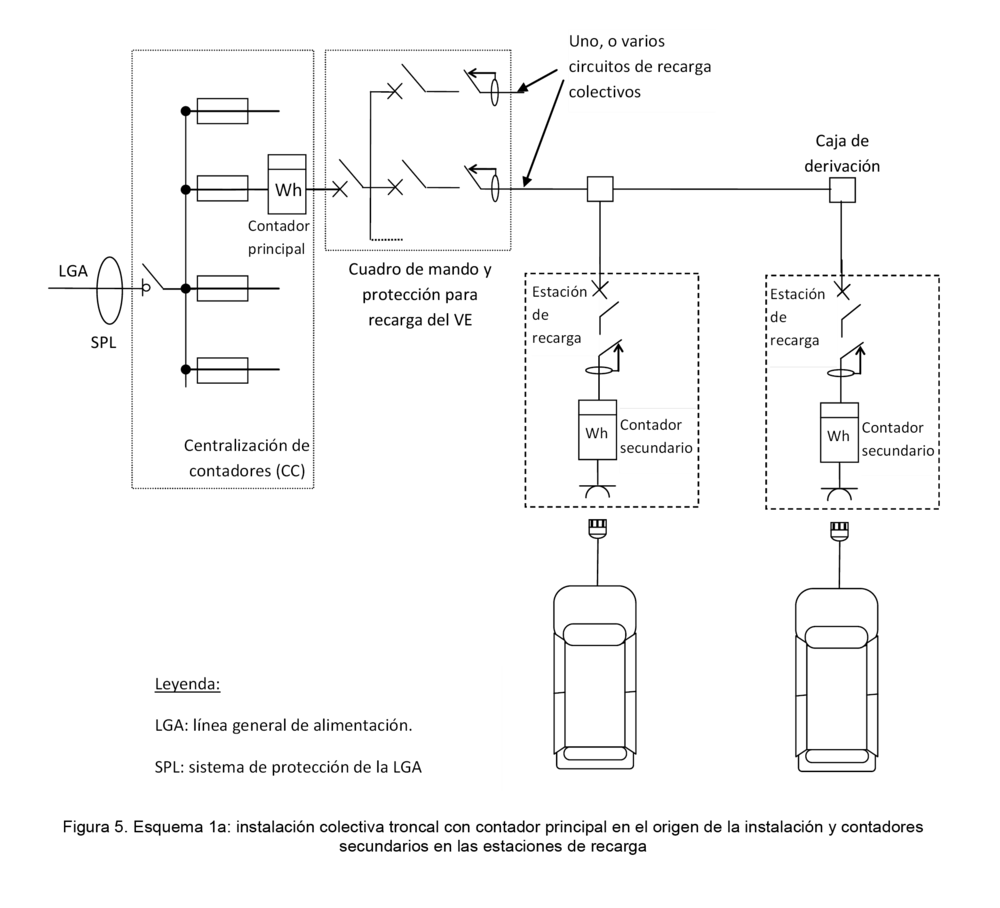
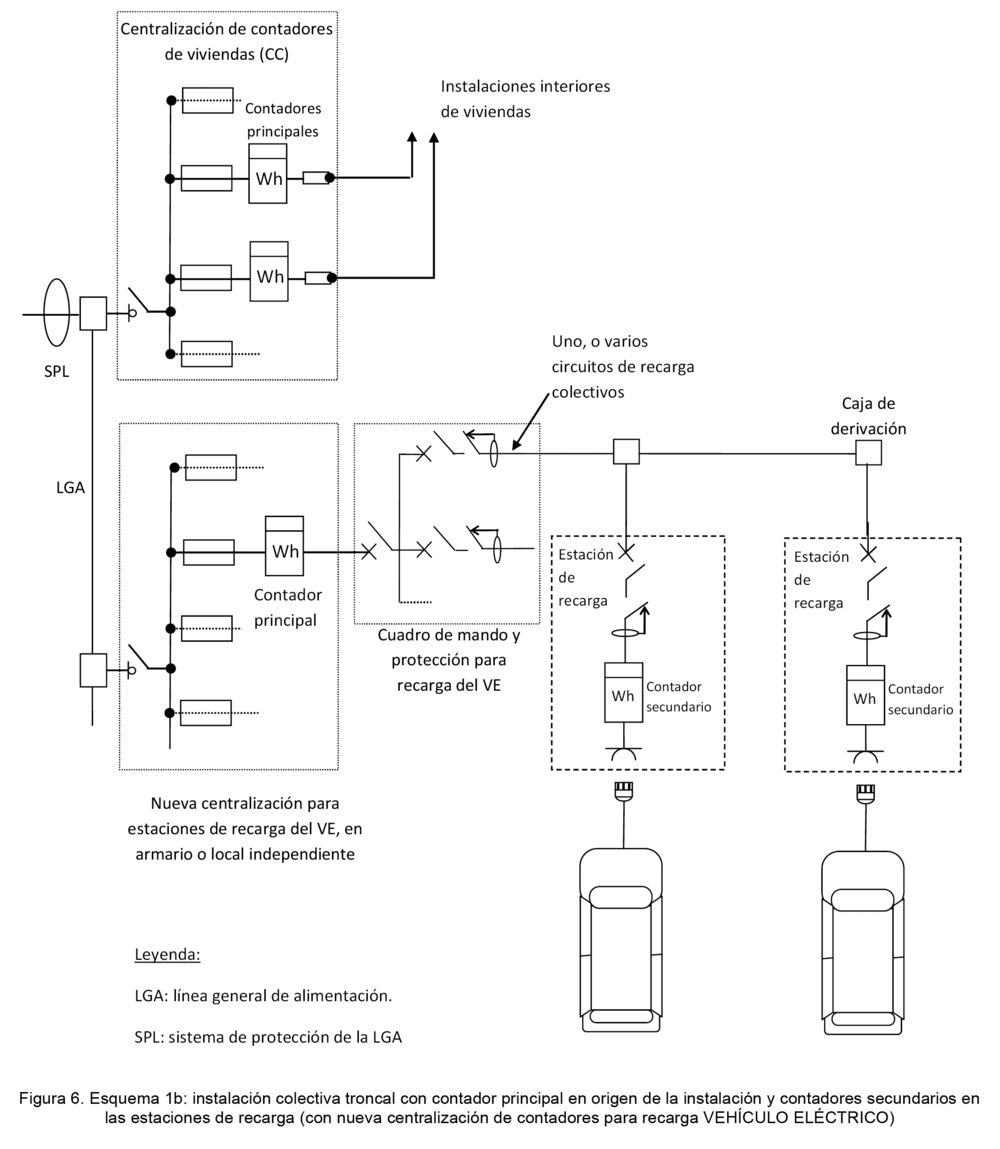
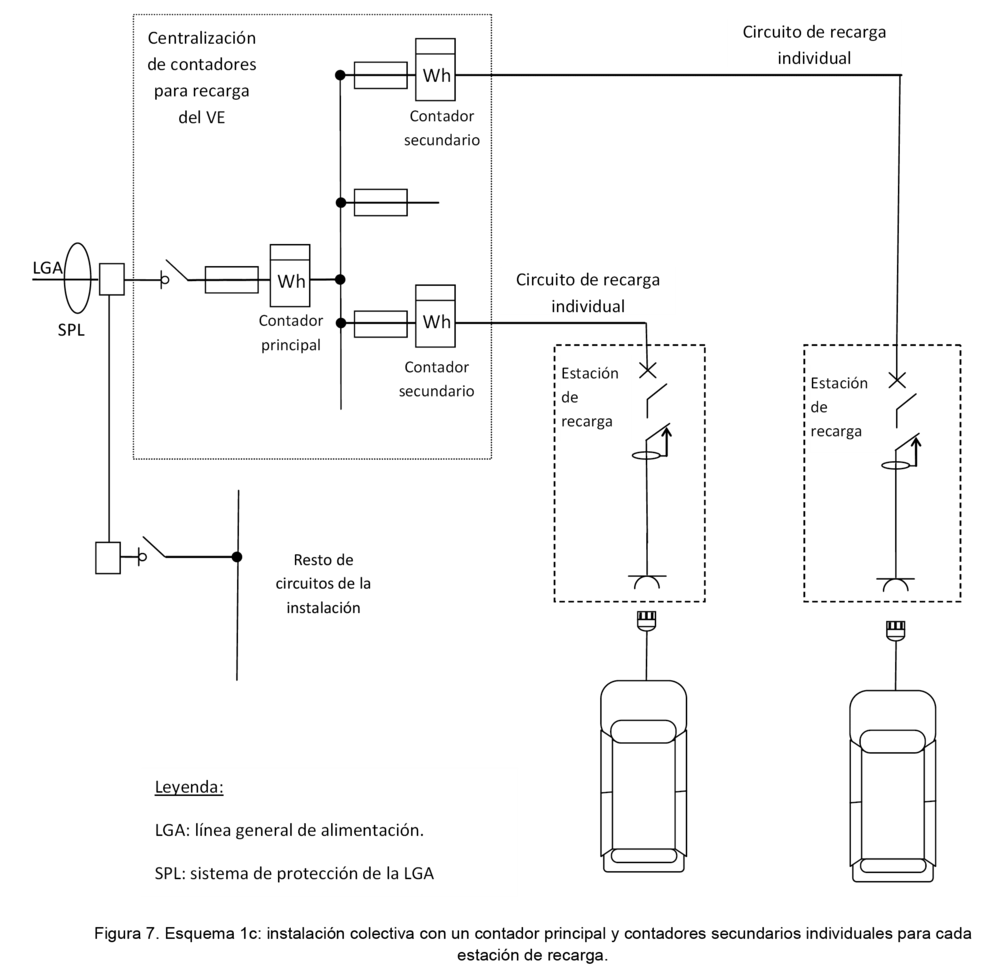
I. Collective or trunk scheme with a main meter at the origin of the installation. Three versions are derived from this scheme: 1a, 1b and 1c.
Collective or trunk scheme 1a of ITC BT-52:
Collective or trunk scheme 1b of ITC BT-52:
Collective or trunk scheme 1c of ITC BT-52:
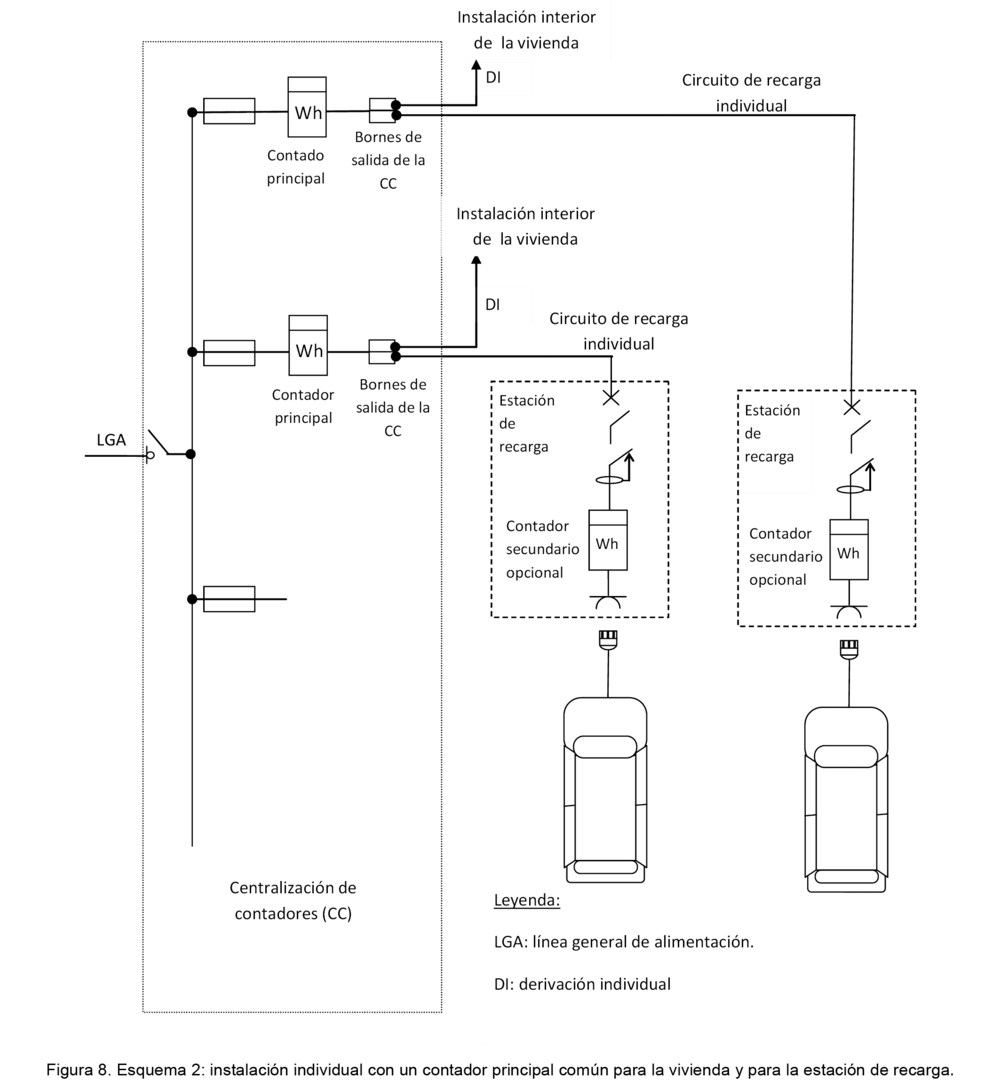
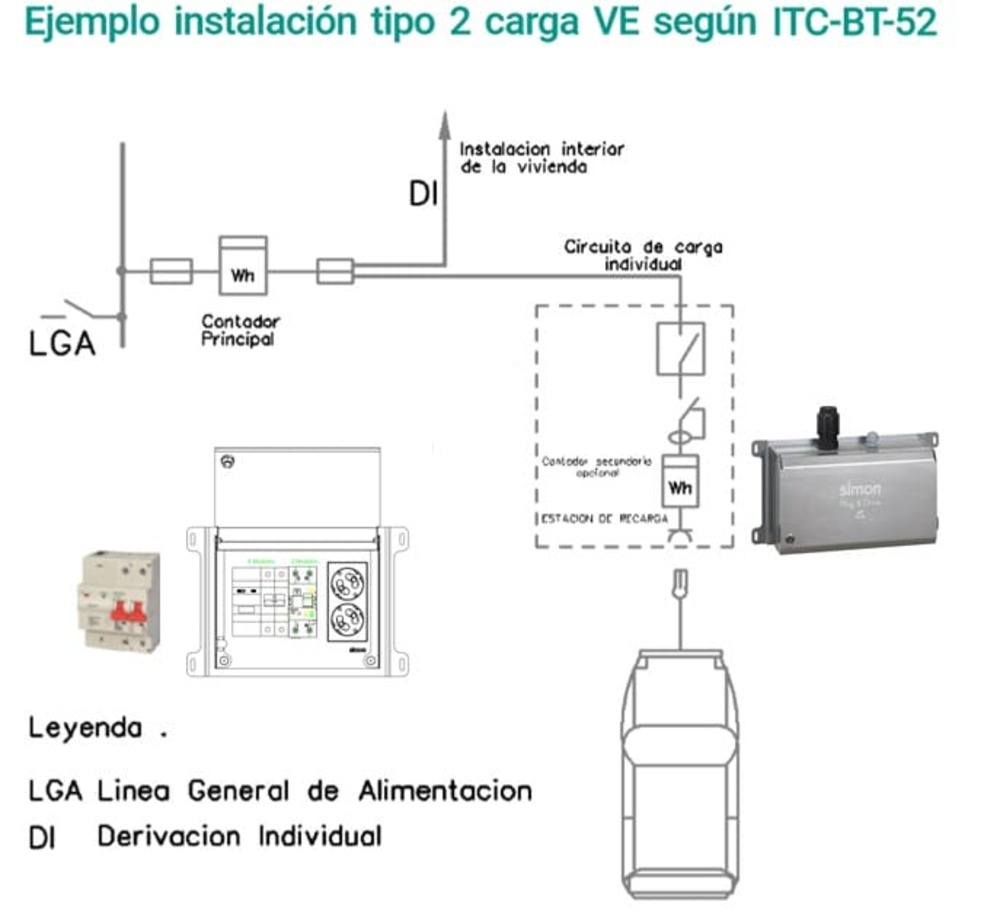
II. Individual scheme with a shared meter for the home and the charging station.
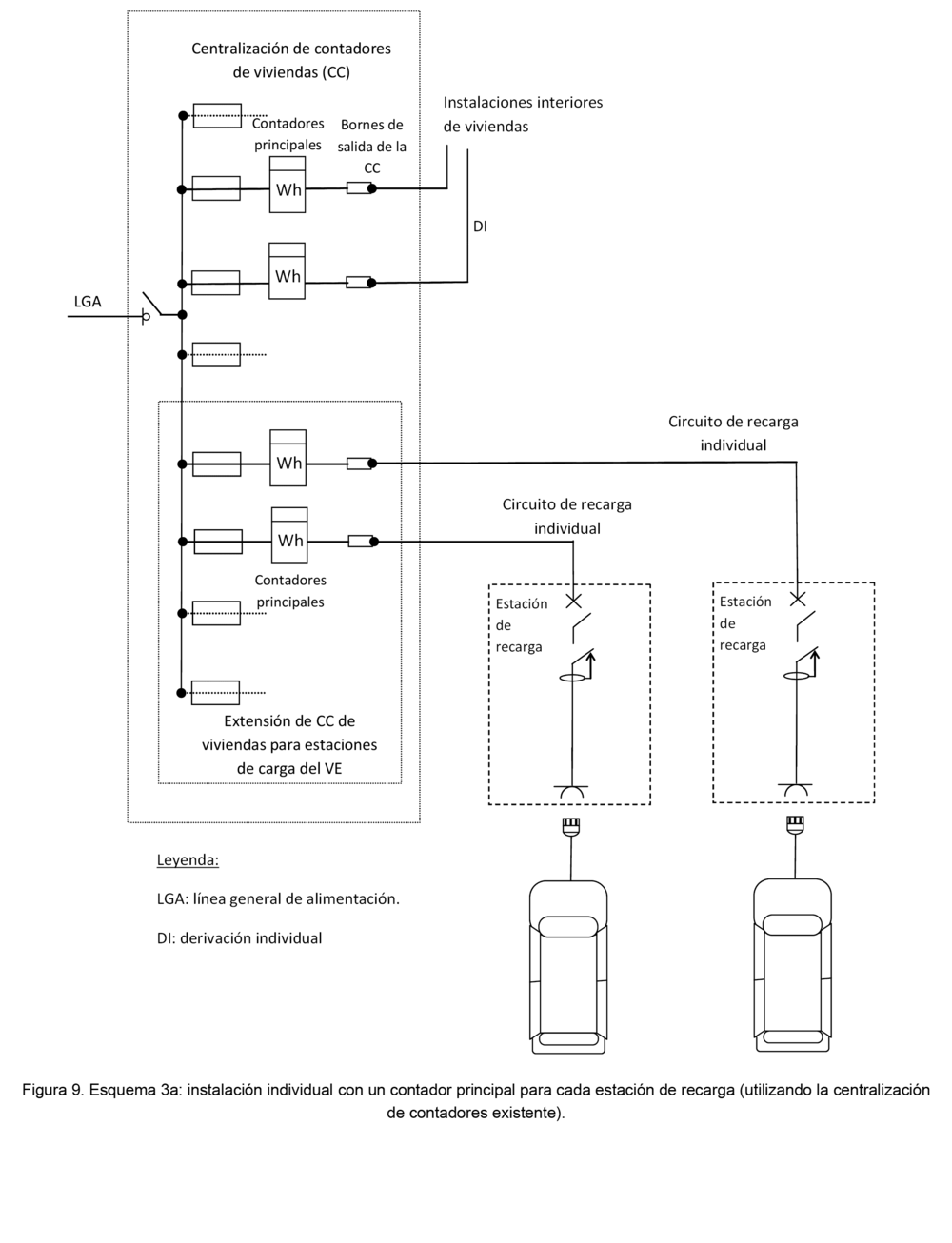
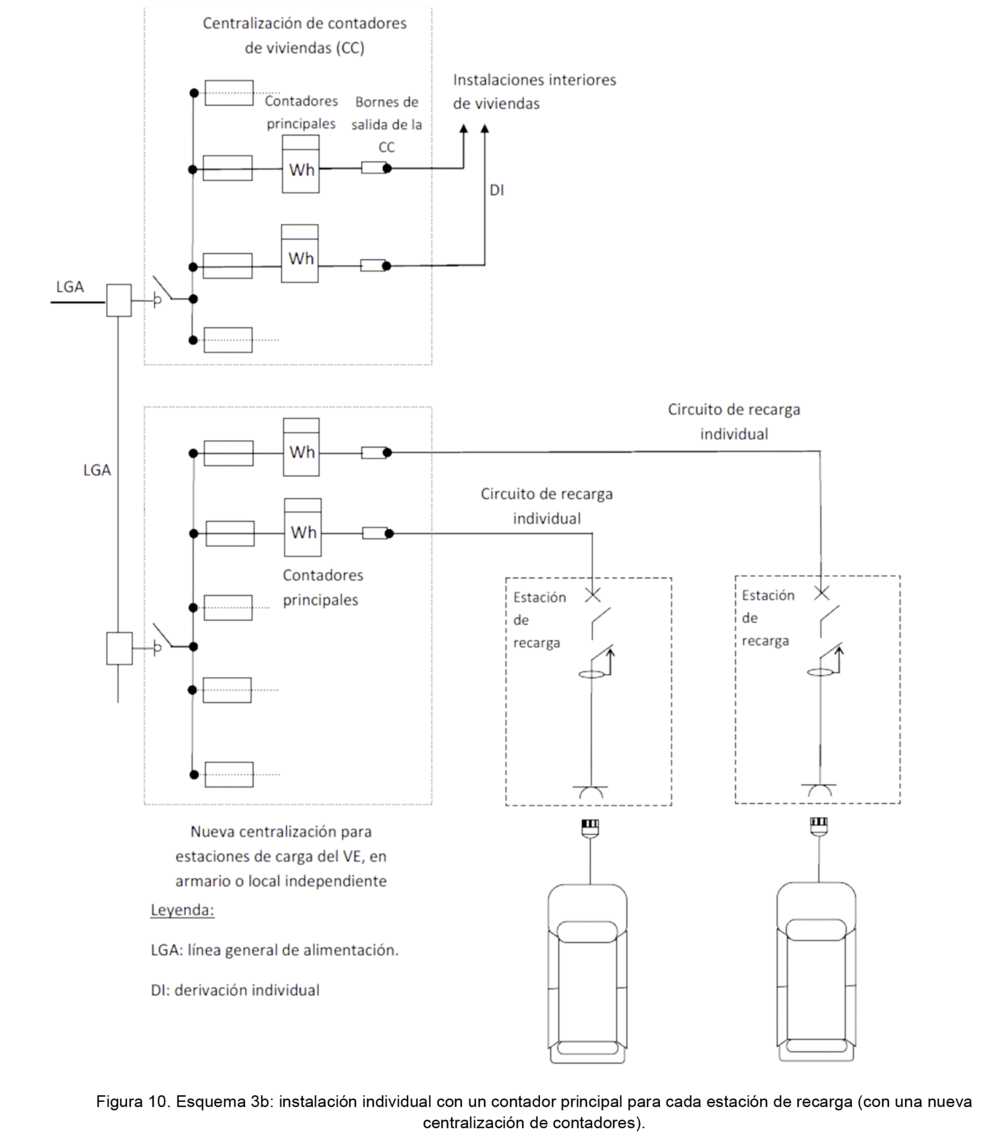
III. Individual scheme with a meter for each charging station. Two versions are derived from this scheme: 3a and 3b.
Individual scheme 3a of ITC BT-52:
Individual scheme 3b of ITC BT-52:
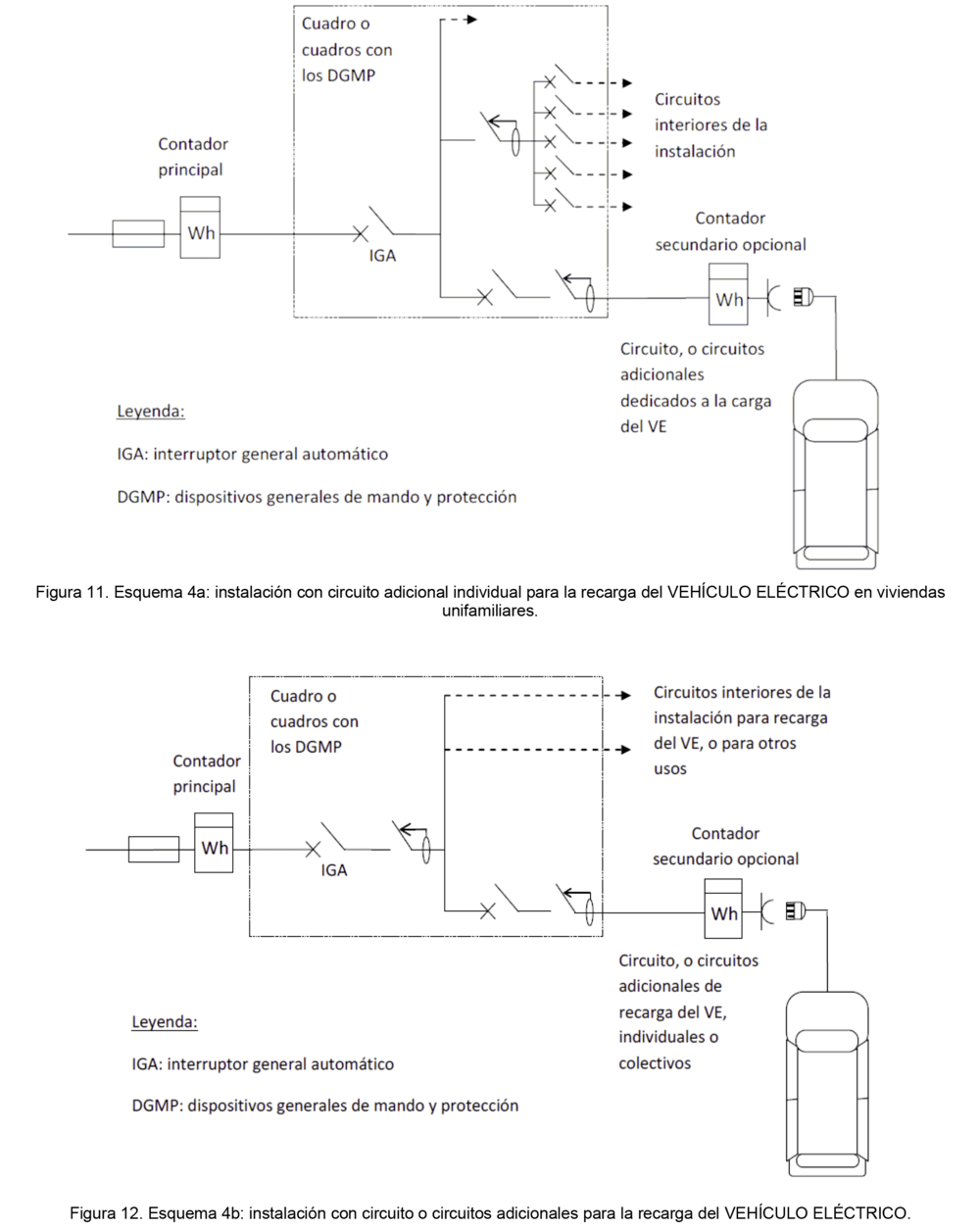
IV. Scheme with one or more additional circuits for electric vehicle charging. Two versions are derived from this scheme: 4a and 4b.
Schemes with additional circuit 4a and 4b of ITC BT-52:
What solutions does the technical application guide of ITC BT-52 propose?
Since the publication of ITC BT-52, one of the most overlooked aspects has been the need to include an automatic or manual reset system when the home's Power Control Switch (ICP) trips.
This reset prevents the user from having to walk to their parking space or to the meter cluster to restart charging.
Why a reset system is necessary
In new homes, the ICP is built into the digital meter.
If the meter detects a load connected, it does not allow automatic reset for safety reasons.
Therefore, the charging point must be temporarily disconnected when the ICP trips, leaving the meter “empty” so it can reset.
What was happening until now?
For years, especially in installations with scheme 2 (double individual branch), reset systems were hardly installed because they required an additional circuit from the home, which made the installation more expensive.
What changes with the updated Technical Application Guide?
The ITC BT-52 Technical Application Guide (2017) introduced a key improvement:
Allowing automatic reset from the meter cluster or from the charging infrastructure itself, with no need for additional cables to the home.
This has noticeably simplified and lowered the cost of charging solutions.
Automatic reset solutions for charging infrastructure
The ITC BT-52 guide recognises two valid architectures for implementing automatic reset:
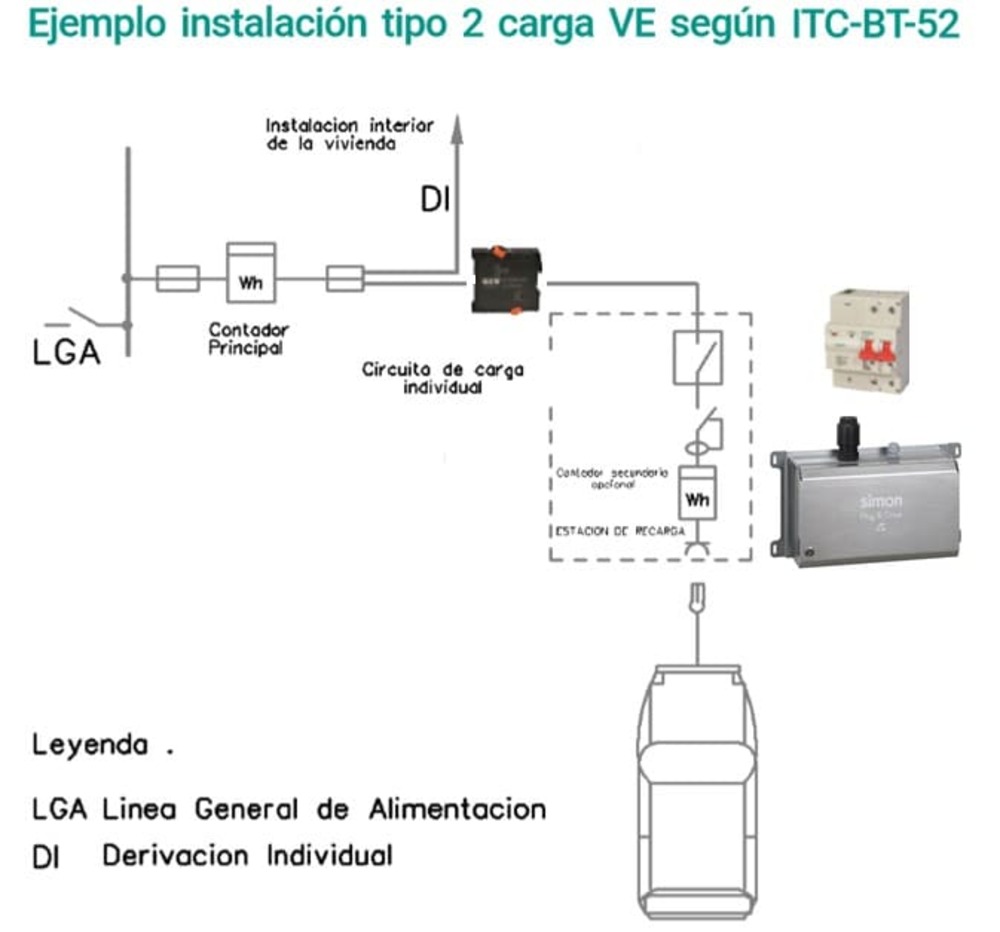
Solution 1. Reset via an electronic device connected to the meter
A device detects when the ICP trips.
It activates or deactivates the coil of a contactor that powers the charging point.
When the ICP resets, the device reconnects the charging.
It must be installed in the meter cluster or in a separate enclosure.
Diagram of the first solution for automatic reset under ITC BT-52:
Solution 2. Reset integrated into the electrical protection of the charging circuit
The mandatory surge protection may include a mechanism that detects the ICP trip.
This mechanism acts on the breaker of the charging circuit (also mandatory).
When the ICP resets, the protection detects it and reconnects the charging point after a short delay.
It can be located inside the charging enclosure itself or in an external enclosure.
Diagram of the second solution for automatic reset under ITC BT-52:
Conclusion
Both solutions comply with ITC BT-52, and the options that reduce costs and simplify installation are expected to become widespread in the coming years.
How many ITC BT are there?
According to the Low Voltage Electrotechnical Regulation, there are a total of 52 ITC BT. In that PDF document you can check all the complementary technical instructions currently in force.
These ITCs cover various areas of the regulation for low voltage electrical installations, covering aspects from the installation of lighting and power systems to special-purpose installations, as in the case of this ITC BT-52, focused on infrastructure for electric vehicle charging.
Frequently asked questions about ITC BT-52
ITC BT-52 raises many questions among users, installers and homeowners' associations. To help you understand the essentials, here is a selection of frequently asked questions with clear, up-to-date answers. You can add to, change or expand any of them depending on the focus of your page.
Is it mandatory to install a charging point under this regulation?
ITC BT-52 does not require installing a charging point, but it does regulate how to do it when one is installed. In new buildings with car parks, the Spanish Technical Building Code (CTE) does require pre-installation to make the future installation of charging points easier.
Which scheme is best for a homeowners' association?
In most cases, the most advisable is Scheme 2 (individual branch from the meter cluster) because:
It allows each user to have their own meter and contract.
It avoids depending on the homeowners' association for energy.
It makes future expansions easier without affecting other neighbours.
Other schemes can be appropriate in specific cases, but Scheme 2 is the most widespread and flexible.
How many other ITC BTs are there?
The Low Voltage Electrotechnical Regulation includes 52 Complementary Technical Instructions (ITC BT). Each addresses a specific area of low voltage electrical installations, and BT-52 is the one dedicated to electric vehicle charging infrastructure.
How does ITC BT-52 affect the ICP or digital meter?
The regulation requires that the charging point disconnects automatically if the ICP of the digital meter trips. This allows the meter to reset without detecting any load, which is essential in modern meters. For this reason, many installations include automatic reset systems that comply with the technical guide of ITC BT-52.
Can I charge my electric car in the shared garage?
Yes. The Spanish Horizontal Property Law (Ley de Propiedad Horizontal) allows you to install a charging point in your garage space without needing the homeowners' association's approval.You only need to notify in writing and bear the cost of the installation. ITC BT-52 sets out how the installation must be carried out so it is safe and compatible with the rest of the building.
We can conclude by stating that ITC BT-52 has consolidated itself as the essential reference for ensuring safe, efficient charging installations prepared for the growth of the electric vehicle.
This instruction provides a clear framework that supports decision-making for both users and associations, simplifies integration with digital meters and ICPs, and allows reliable, cost-effective solutions to be planned that accompany the transition to more sustainable mobility.