Electric vehicle charging stations in Spain are the main enablers of the electrification of the country's vehicle fleet. Promoting the use of sustainable cars is pointless if the road infrastructure does not have the charging points needed for the convenient, fast refuelling of drivers of this type of vehicle.
Electric vehicle charging stations: map, price and free points
12 min read
)
Learn how to find an electric vehicle charging station near you, how much charging costs and where there are free charging points in Spain.
This is where the MOVES III Programme and the Plan España Auto 2030 come in, focused on encouraging sustainable mobility through a set of incentives and a raft of measures that seek to support the supply and demand of electric vehicles, particularly the most affordable ones manufactured in Spain.
The other good news is that the multiplication of electric car charging stations does not depend solely on the State. Companies and individuals can also install their own charging points, which also serve as very attractive aesthetic elements, embellishing the surroundings with their modern, cutting-edge designs.
What is an electric vehicle charging station?
An electric vehicle charging station is a fixed installation designed to supply electricity for recharging the batteries of different types of electric vehicles (cars, motorcycles, buses, trucks, etc.). Some batteries that benefit from this type of charging are lithium-ion, lithium polymer, lithium iron phosphate and solid-state.
Charging stations are classified as:
Simple charging point, made up of the necessary protections, one or more sockets that are not specific to electric vehicles and, where applicable, the enclosure.
SAVE-type charging point (Specific power supply system for electric vehicles).
How does an electric vehicle charging station work?
An electric vehicle charging station works through the following components:
How do you use an electric vehicle charging station?
The way to use an electric vehicle charging station is as follows:
If you want to know more, read our article on How to charge an electric car?
Types of electric vehicle charging stations
Broadly speaking, we can talk about 4 types of vehicle charging stations electric, whose individual characteristics deliver different charging times.
Let's see:
However, beyond the types of stations, bear in mind that the time an electric vehicle takes to charge also depends on other key factors. The car's make and model, its type of battery, its electric range, the charger's power, the vehicle's initial charge level and even the local climate are all elements that influence charging times.
For example, ultra-fast charging speeds can only be reached by certain cars in particular, such as the Audi e-tron GT or the Porsche Taycan.
Types of connectors for charging an electric car
Alongside the increasingly notable popularisation and expansion of electrified motoring, different solutions have been developed to recharge electric vehicle batteries.
Depending on whether they are connectors for alternating current or direct current, on the market we can find the following types of connectors:
1. Types of charging connectors for alternating current:
2. Types of charging connectors for direct current
How much does a charge for an electric car cost? (price)
The cost of charging an electric car is calculated by multiplying the battery's charging capacity by the price of electricity. This simple formula is very easy to apply for normal sockets or stations located in domestic or business environments. You just multiply the number of kWh consumed by the battery by the kWh rate shown on the electricity bill.
However, when it comes to the use of public charging stations, the price of charging electric vehicles is usually between €0.15 and €0.80 per kWh. These prices vary depending on several factors, such as the type of station used and its charging speed (the faster the charge, the more expensive). And the same formula applies here: multiply the number of kWh consumed when charging the battery by the rate set at the time.
In this respect, the cost of charging an electric vehicle depends on the make and model of the car (since this influences the battery's capacity), as well as on the type of charging used, since rates vary depending on whether it is a residential, business or public environment.
How much does it cost to install an electric car charger at home?
As for the cost of installing an electric car charging station at home, it usually ranges from €1,500 to €2,000, depending on the characteristics of the system to be purchased. For example, prices vary depending on whether the system has protections or not, includes a MID meter for re-invoicing consumption or not, and also takes into account the number of complementary accessories.
This average cost of the home electric car charger includes the purchase of the equipment, standard installation (up to 20 metres), the legalisation procedures and, where applicable, the subsidies available through the MOVES III Programme or other programmes in force.
An important aspect to consider is that, through the MOVES III Programme, you can obtain up to a 80% subsidy on the cost indicated above. This applies to private individuals, homeowners' associations, self-employed workers and companies, and has made it possible to mobilise more than €1.5 billion in support for electric mobility.
How many electric vehicle charging points are there in Spain? (free and paid)
At the time of writing, there are more than 50,000 publicly accessible charging points in operation, not counting private-use points in homes or businesses. There are also several thousand charging points already installed that are not yet operational due to administrative or technical reasons, such as delays in connecting to the grid or breakdowns.
Among the operational points, there are a large number of free electric vehicle charging stations, some located in busy public places (such as airports and train stations), and others installed in private locations to improve the customer experience (such as restaurants, hotels, dealerships, shopping centres, among others).
Electric vehicle charging stations near you (map)
To find electric vehicle charging stations near your location you can use two methods. One of them is to check the charging point map on Google Maps, a platform that will use your GPS to recommend nearby sites. To do this, simply open Google Maps and enter keywords such as “electric vehicle charging”, “electric car charging point”, “EV charging”, etc. into the search bar. You can also narrow the search by filtering results based on the type of connector your vehicle uses.
Other fairly popular options are the platforms Place to Plug and Electromaps. They are interactive digital platforms specialised in displaying a map with charging stations, which you can filter by different criteria, such as minimum charging power, connector type and the type of location of the charging point.
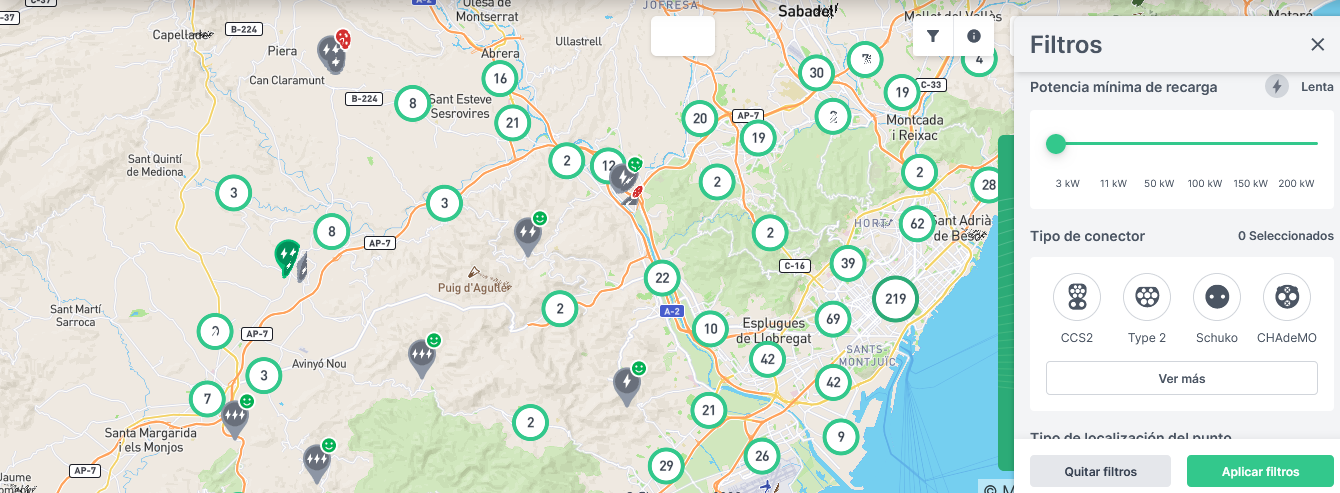
Electric vehicle charging stations across the different provinces
At present, the highest number of electric vehicle charging stations in Spain is located in Catalonia, followed by Andalusia and then Madrid.
Here is the ranking of the 10 provinces in Spain with the most available charging points:
Barcelona
Madrid
Alicante
Valencia
Mallorca
Girona
Seville
Asturias
Málaga
Tarragona
How long it takes to charge an electric car
Although electric cars are becoming increasingly popular, there are still many drivers who don't dare to swap a combustion car for an electric one because they think the charging time is excessive. But… how long does it really take to charge the battery of an electric car?
The time it takes to charge electric cars depends on several factors, some related to the vehicle's characteristics, such as battery capacity or the integrated connector, and others with the parameters of the charging point (connector).
For example, if we use a considerably powerful charger (22 kW) to charge a battery of fairly large capacity (95 kWh), we can complete the charge in around 3 hours. Conversely, using a low-power charger (3.6 kW) we would need approximately 19 hours to charge the same battery.
The main factors that influence the charging time of an electric car are:
The vehicle's battery capacity: in principle, the larger the battery's capacity (which can currently range from 33 kWh to over 100 kWh, depending on make and model), the more time we'll need to charge it. In practice, however, everything depends on the type of integrated charger and the characteristics of the charging point we use.
Type and power of the integrated charger: today, electric cars don't only run on alternating current, which is slower, but many models also run on direct current, which supports much higher power levels and is therefore much faster. Therefore, the charging speed will depend on the technology, battery type and class of charger built into the vehicle.
The charging point used: obviously, we won't get the same speed connecting the vehicle to a Schuko socket (the typical socket we have at home for connecting the fridge, the television or any household appliance) as we would at a fast station known as a Wallbox. With a domestic socket it can take up to 24 hours to charge a battery, whereas with Wallboxes, where it is possible to use Type 2 or Mennekes connectors, the full charge is reduced to around 7 hours. A higher level is provided by so-called public ultra-fast chargers, with the capacity to charge a high-power battery in 30 or 60 minutes.
Summary table of full battery charging time. Examples:
Factors to consider
Charging time*
Conventional domestic socket (Schuko 2.3 kW)
20-30 hours
Single-phase AC charging point (wallbox 7.4 kW)
6-10 hours
Three-phase AC charging point (11 kW)
4-6 hours
Three-phase AC charging point (22 kW)
2-4 hours
Fast DC charging station (from 50 kW)
1-1.5 hours
Ultra-fast DC charging station (from 100 kW)
30-45 minutes
* Indicative times for a medium-capacity battery (around 50-60 kWh) and ideal charging conditions. In practice, the real times depend on the initial state of the battery, the vehicle's charging curve and the effective power available at the charging point.
How does a charging station turn electricity into energy for your electric car?
The process of converting electricity into energy capable of moving the tyres of an electric car begins when the electric vehicle is plugged into a charging point, whether private or public.
At this moment, a connection is established between the vehicle and the station, with the aim of having the station supply electricity to the vehicle, which is used to recharge the battery.
The question is… how does that electricity end up turning into energy for your electric car? This is possible because behind an electric vehicle charging station there is a complex system that ultimately makes it possible to transform electricity into charge for the batteries of the vehicles. To do so, rectifiers are used, components that make it possible to transform the electric current into direct current, with the capacity to charge electric car batteries.
But in addition to the rectifiers, many other elements come into play, since charging stations also include management and control systems in charge of guaranteeing the safety of vehicles and people, controlling the energy supply and overseeing the whole process.
The future of charging stations involves the further development of innovations that extend vehicle range (so they can travel more kilometres without recharging), while making vehicle charging more affordable, convenient, green and sustainable for everyone.
Which electric vehicle charging station manufacturer is right for me?
Electric mobility is an increasingly present reality worldwide, and this has meant that in countries like Spain you can find many companies that sell and install electric vehicle chargers.
Faced with this wide offer, the advisable thing is to buy the electric vehicle charging station through a specialised supplier that also has a long track record in the energy efficiency market, such as Simon.
What can we offer you at Simon?
At Simon we drive e-mobility through our highly comprehensive range of electric chargers. We offer versatile, flexible electric vehicle charging solutions for both private and public spaces.
These are our effective, complete charger solutions for electric vehicles:
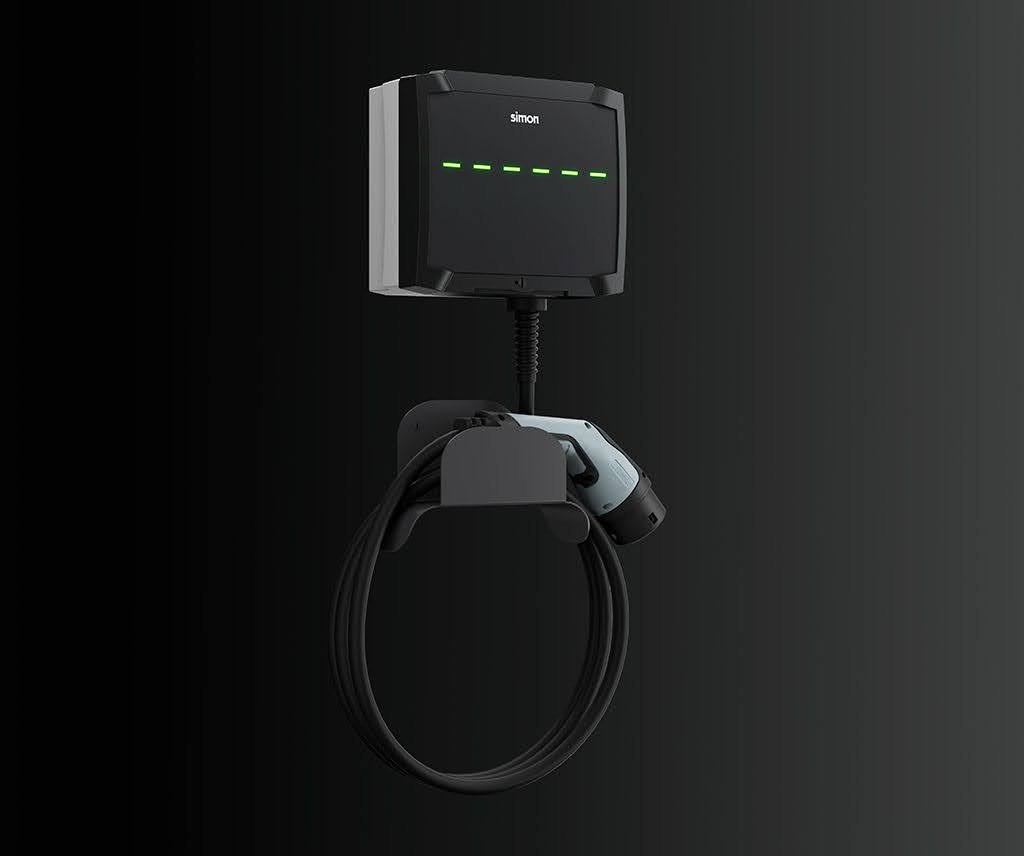
Charging solutions for residential environments: Electric vehicle charging points are gradually entering our homes and buildings.Simon SM30 and SM40 is a residential solution for single-family homes or homeowners' associations, which allows charging with a maximum permitted current of 32A and power levels from 7.4 kW (single-phase charging) to 22 kW (three-phase charging).
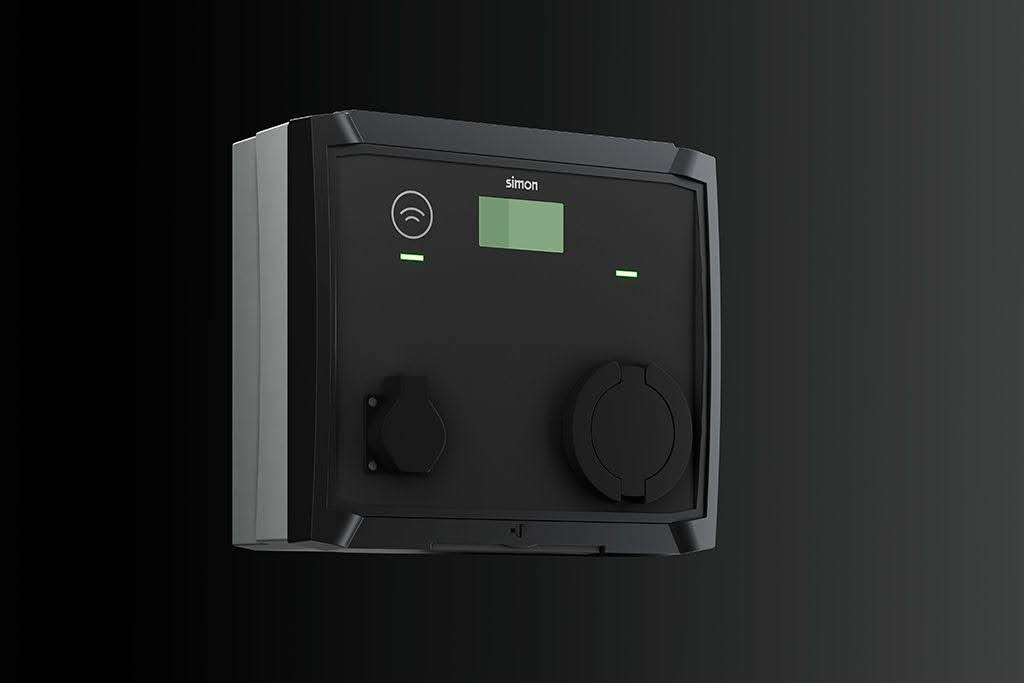
Charging solutions for businesses: We help you turn the conventional parking spaces at your business into sustainability commitments, fostering ecological, green electric mobility.Simon Xenon is an ideal business solution for car parks, hospitals, hotels, shopping centres, office buildings, logistics centres, etc. It uses currents between 10A and 32A, power levels from 7.4 kW (single-phase charging) to 22 kW (three-phase charging), enabling semi-fast charging.
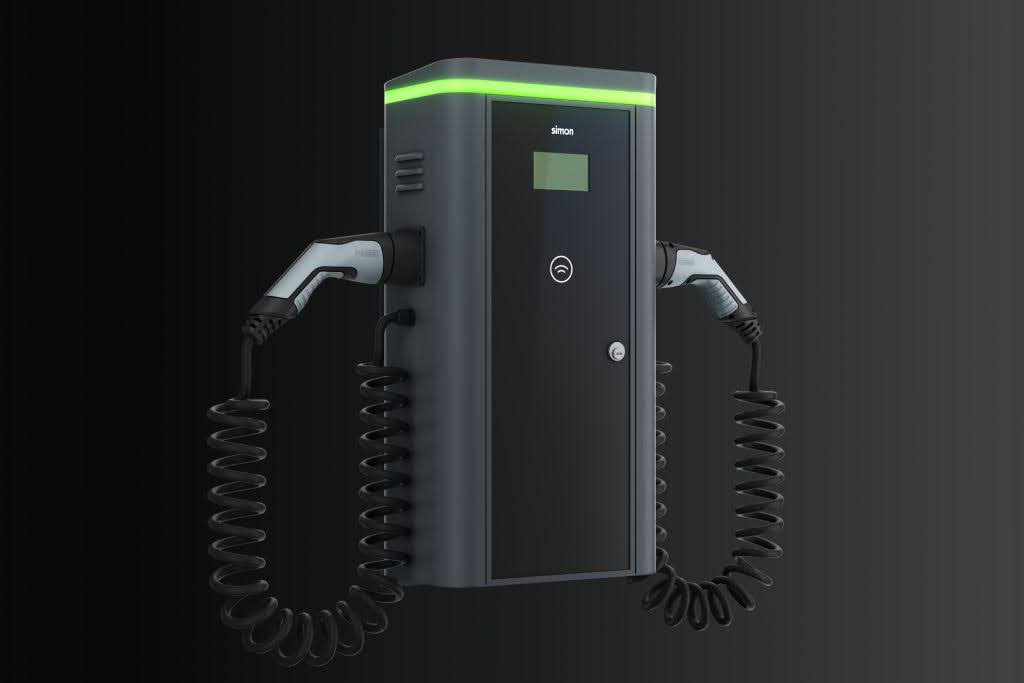
Charging solutions for public spaces: Cities are evolving towards the Smart Cities concept: modern, sustainable, ecological cities that are friendly for their inhabitants. In this context, charging an electric vehicle at any point in the city is becoming an increasingly demanded need.Simon Neon and Simon Argon are solutions specially designed for urban environments, whose elegant, robust design guarantees the protection and durability of the internal components against any type of environment or climate. It uses a current of 32A and power levels ranging from 14.8 kW (7.4 kW per socket) to 44 kW (22 kW per socket).
At Simon we make available to any type of user (individual, business or public) a broad technological ecosystem for installing electric vehicle charging stations. Our entire range of solutions is customisable and configurable to suit the needs and comforts required, with accessories for charging points that have efficient, modern and cutting-edge designs.