Marked by sinuous forms inspired by nature and a combination of geometric figures such as the hyperbolic paraboloid, hyperboloid, helicoid or conoid, giving rise to seemingly impossible structures, Antoni Gaudí's architecture is also synonymous with religion, symbolism and light. A light that also inspires Simon's work, from where, as we approach the 100th anniversary of the death of the leading figure of Catalan modernism, we want to pay tribute to the career of an architect who continues to amaze through his impressive legacy.
)
As the centenary of his death approaches, Antoni Gaudí remains a benchmark in the integration of architecture, nature and light.
Natural lighting in Gaudí's spaces
Through the relationship with light of the man many call the ‘Architect of God', as a further compositional principle in which the symbolic dimension and emotional play a fundamental role, we enter the work of a master endowed with great creative capacity, who conceived each project through an integral approach, where architecture coexists with other artistic disciplines such as sculpture, ceramics, ironwork, carpentry and stained glass. Sculptural and magical places, full of contrasts, that Gaudí knew how to fill with a Mediterranean light he considered perfect.
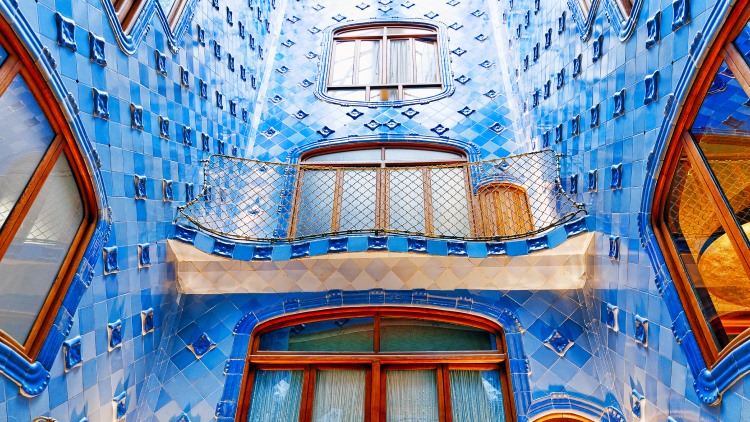
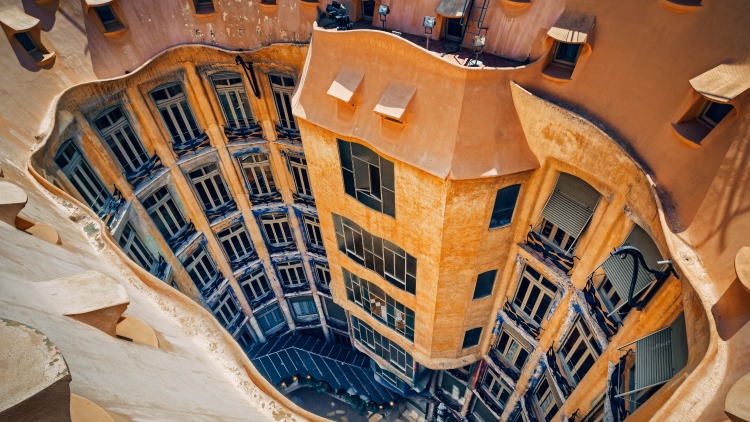
As one more architectural element, light is integrated into Gaudí's architecture from his earliest sketches, through devices that also integrate colour and form, allowing it to go beyond its functional role and emerge as a spiritual element. Courtyards such as the one at Casa Batlló, where tiles in different shades of blue create a characteristic gradient effect, or those running through La Pedrera (Casa Milà) to maximise natural lighting and ventilation; stained-glass windows that create dynamic effects and turn light into a living element; or the striking sculpted surfaces of the Sagrada Familia, which add a symbolic and emotional dimension akin to that of Gothic cathedrals.
Light as a compositional principle
To maximise the intake of natural light and create shifting effects throughout the day, Gaudí designed his buildings taking the sun's movement into account, as living beings in constant movement. Spaces deeply connected to nature and the passing of the seasons, such as the Sagrada Familia, where the cool stained glass of the morning contrasts with the warm tones of the evening, with a nod to the process of birth and death; or Torre Bellesguard, where the white walls act as a backdrop for the reflections of coloured glass that shifts with the sun's position.
Colour, form and transparency
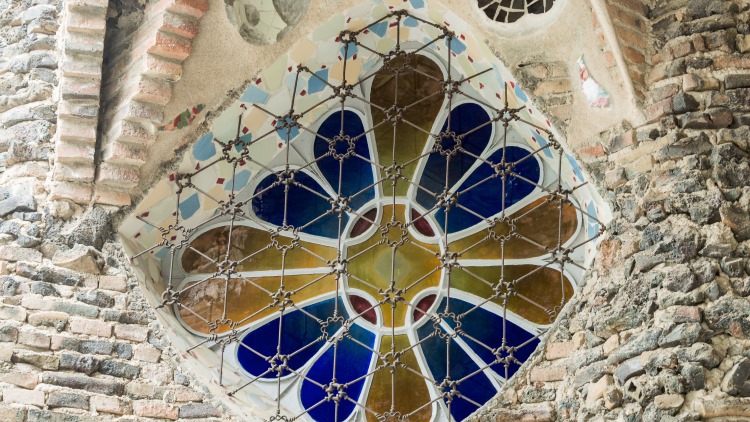
Gaudí created innovative techniques such as the ‘trencadís', which uses broken fragments of ceramic or glass to create colourful, textured surfaces such as those at Casa Batlló; or a trichromy system with four layers of overlapping glass (three coloured and one transparent), giving the stained glass volume and a graded colour effect. A careful treatment of materials, where morphology also plays a key role and gives rise to projects like the Cripta de la Colònia Güell, with light similar to that filtering through the shadows of trees in a forest, working as a great sundial.
The symbolic and emotional dimension of light
Spirituality and a deep connection with the divine find their highest expression in the Sagrada Familia, conceived by its creator as a great bible built in stone and inspired by a nature that for Gaudí is the purest expression of God. As in Gothic cathedrals, where light was considered a manifestation of divine presence, here the stained glass allows for a symbolic message through light and colour, immersing visitors in a magical atmosphere where, as the architect himself said: ‘architecture is the ordering of light; sculpture is the play of light.'
Towards a conscious use of light
Gaudí's way of understanding and treating light finds continuity in the increasingly important role this resource plays in architecture and design — two disciplines that are betting on reconnection with the natural environment and an approach centred on biophilia, well-being, efficiency and sustainability, where aspects such as orientation, the integration of efficient windows and skylights, or the use of materials that maximise the intake of light, are fundamental. The fact that the great master of Catalan modernism managed to give his buildings great luminosity without major technological advances — through materials, volumes and colours — shows that an architecture that respects the planet and is aligned with the natural environment is possible.
Text by Laura Novo